Morphly
A comprehensive platform for document transformation and media processing. It employs a microservice architecture to orchestrate secure file handling, AI-powered image manipulation, and high-fidelity document conversion.
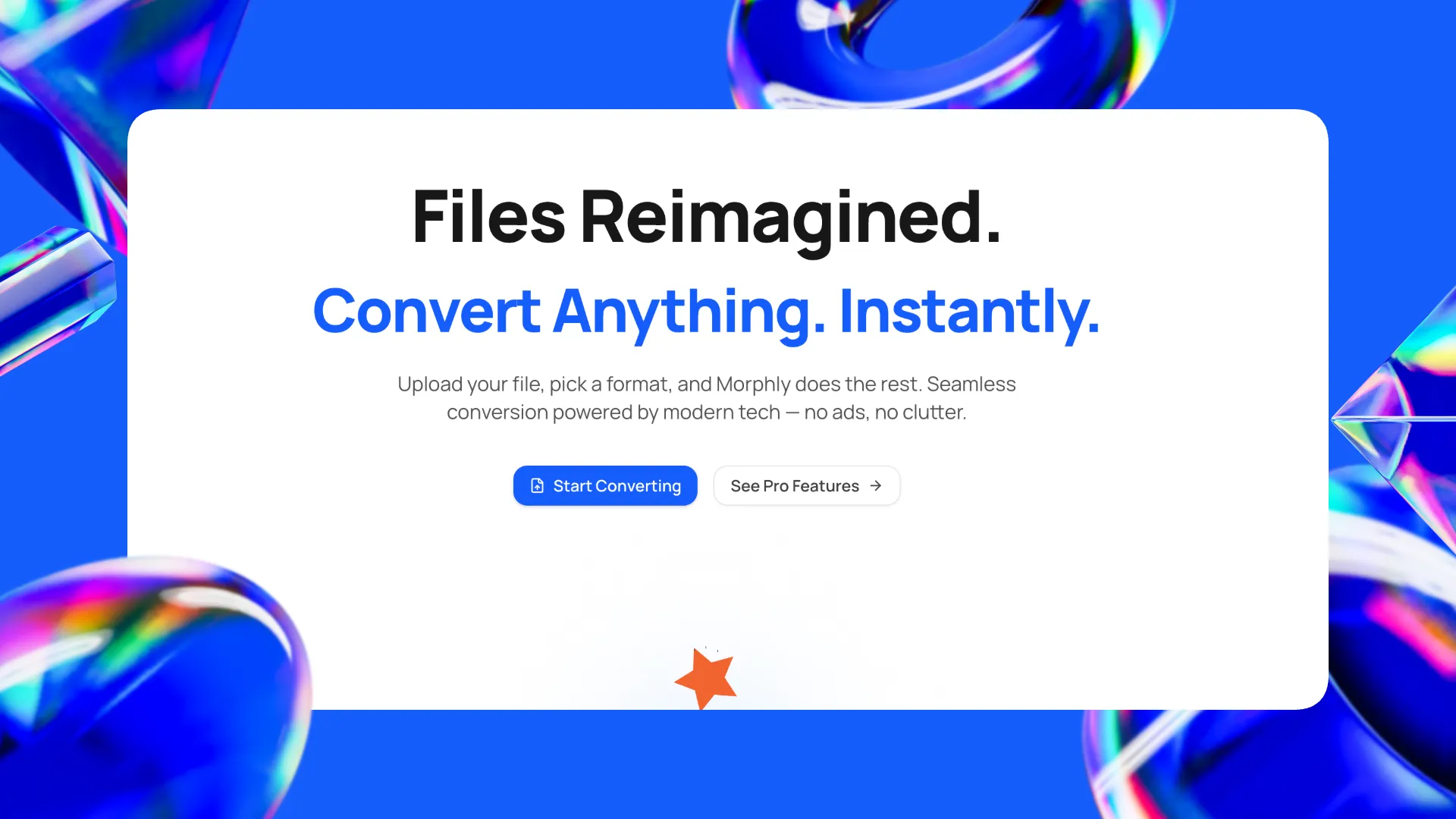
Morphly: Service-oriented file utility and conversion platform
Overview
Morphly is a file utility platform engineered to unify disparate digital workflows—such as PDF conversion, background removal, and document manipulation—into a single interface. Unlike standard CRUD applications, Morphly is designed to handle complex binary data streams. It utilizes a service-oriented architecture to isolate heavy computational logic, ensuring the core application remains responsive while managing dependencies across Node.js and Python environments.
The Challenge
Users frequently rely on multiple unverified, ad-heavy third-party websites to perform basic file operations. This fragmented approach exposes users to security risks and inconsistent output quality. There was a need for a centralized, secure, and professional tool capable of handling diverse digital assets without compromising user data privacy.
Project Goals
- Engineer a system capable of handling complex Buffer, Blob, and Stream data types beyond standard JSON APIs.
- Implement serverless file processing logic that avoids execution timeouts during heavy manipulation tasks.
- Orchestrate third-party AI models for computationally expensive operations like background removal.
- Establish a secure storage architecture for user assets using presigned URLs and cloud storage providers.
Technical Stack
Frontend
- Next.js 14 (App Router): robust framework for server-side rendering and routing.
- TypeScript: Ensures type safety across complex data structures.
- Tailwind CSS: Utility-first styling for a clean, professional UI.
- Zustand: Lightweight state management for handling file upload queues.
Backend
- Node.js (Next.js API): Handles API routing and orchestration.
- Python (FastAPI): Microservice for AI processing and heavy computation.
- LibreOffice (Headless): Containerized service for high-fidelity document conversion.
Database & Auth
- PostgreSQL: Relational database for structured user and transaction data.
- Prisma: ORM for type-safe database queries.
- NextAuth: Secure authentication handling.
- Supabase: Managed database and auth services.
Infrastructure & Payments
- Docker: Containerization for consistent multi-language environments.
- Vercel & Railway: Hosting for frontend and backend microservices respectively.
- Cloudinary: Cloud storage for media assets.
- Stripe: Payment processing for premium credit management.
Key Features
High-Fidelity Document Conversion
Utilizes a headless LibreOffice container to convert DOCX, PPTX, and XLSX formats to PDF with consistent rendering.
AI-Powered Image Processing
Integrates Python-based AI models for background removal and supports various format conversions (PNG, JPG, WEBP).
Microservice Architecture
Decouples the Next.js web application from Python AI services and file conversion workers to ensure scalability and fault tolerance.
Credit & Quota Management
Enforces file size limits and deducts user credits only upon successful conversion, integrated with Stripe for payments.
Challenges & Solutions
Blocking the Node.js event loop with heavy conversion tasks
Solution: Adopted a service-oriented architecture, offloading CPU-intensive PDF-to-DOCX conversion to a dedicated Python FastAPI microservice communicating via an internal Docker network.
Managing binary dependencies in a serverless environment
Solution: Executed LibreOffice and Python processes in isolated containers to keep complex dependencies out of the main Node.js runtime, ensuring reproducible results.
Roadmap
- Background job queue implementation (Redis / BullMQ)
- Asynchronous conversion workers
- Service-level health checks and centralized logging
- File compression options and format auto-detection
Outcome
The project successfully established a production-ready, Dockerized platform. It demonstrates advanced handling of binary streams and the orchestration of multi-language microservices (Node.js and Python) to solve practical file manipulation problems.
Ready for the next one?
Explore more case studies or get in touch.